

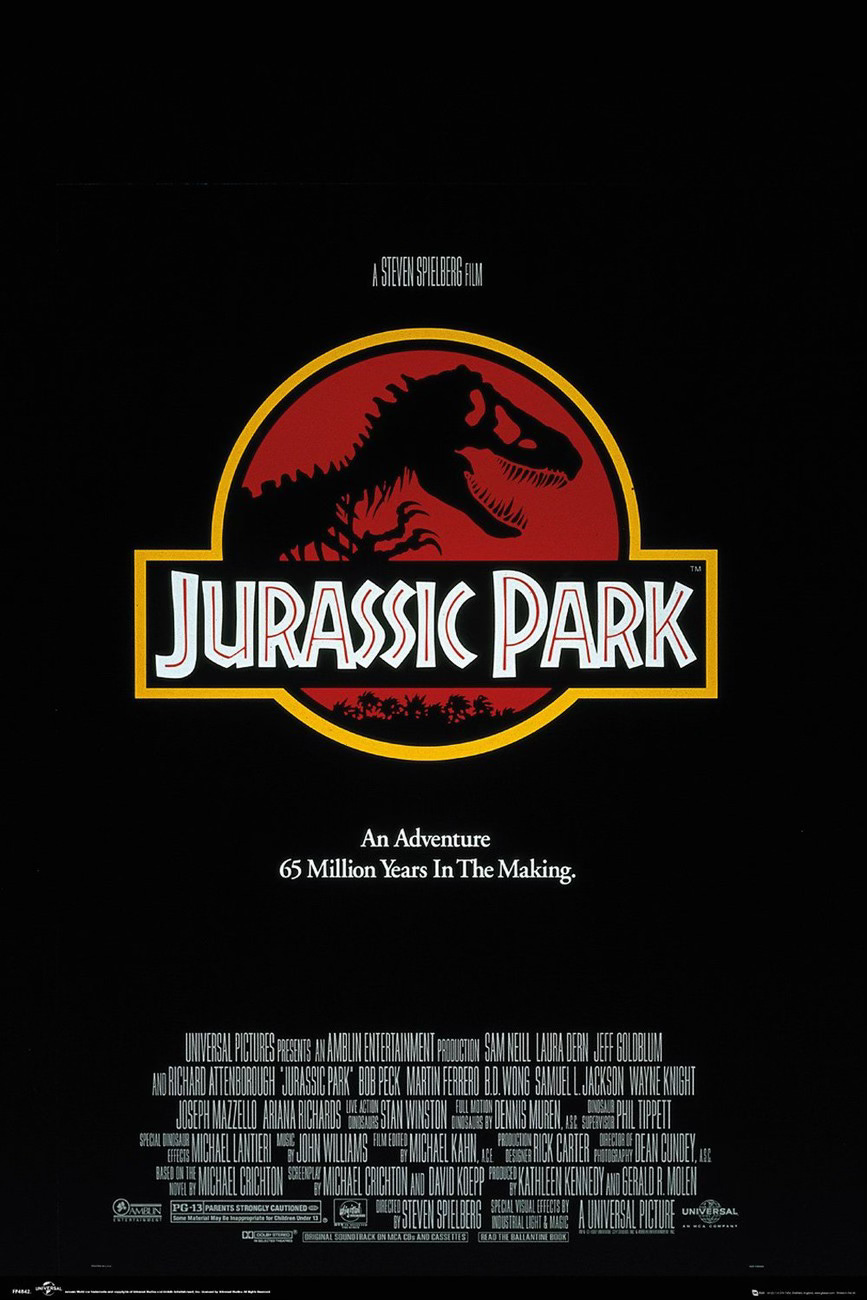
The best movie posters are not necessarily the most aesthetically pleasing, but those that provoke the imagination of the spectator, turning them into storytellers in their own minds as they begin to wonder about the cinematic potential contained within the artwork.
As a child browsing my local convenience store’s DVD shelves, I was always drawn to the cover of Jurassic Park (1993). Strangely, I didn’t actually watch the film until my early twenties. The only dinosaur film I remember seeing as a child was Dinosaur (2000), yet I somehow went through my entire childhood without watching what is arguably the definitive dinosaur film.
It wasn’t that I refused to watch it. Nor did I desperately ask my parents to buy it for me. So why was I captivated by the poster, yet uninterested in engaging with the film behind it? Perhaps, even then, I sensed that the film’s tone might not align with the one I had constructed in my imagination. But how could a poster consisting of little more than a logo provoke such a specific expectation? How could something so minimal generate a film in my head?
How it provokes the imagination
The most striking design element of the poster is its restraint. There are no characters, no scenery, just a logo and a tagline surrounded by blackness. What could be interpreted as minimalism instead becomes invitation. The surrounding blackness functions as a seductive void. It does not present a world; it demands that you create one. The absence of imagery compels the imagination to fill the space. The logo becomes the sole fragment of information from which an entire narrative must be constructed. This feels deliberate. Mystery encourages speculation, and speculation breeds desire.
The emblem tells us we are entering a park inhabited by dinosaurs. But what kind of park? A theme park? A scientific facility? A forbidden wilderness? The skeletal Tyrannosaurus rex immediately establishes seriousness. This is not a friendly, cartoonish dinosaur, it’s a skeleton of the most dangerous dinosaur. The use of a skeleton implies authenticity, something ancient and real.
The colour scheme reinforces this tone. The black silhouette against red evokes danger. The circular design resembles a warning or prohibition sign. The yellow border separating it from the surrounding darkness suggests caution. Nothing about this feels inviting. If anything, it feels hazardous. The T-Rex looms over what appears to be a forest, dwarfing its environment. Its scale suggests supremacy. Humans are conspicuously absent. Where do they fit into this world? Are they explorers? Victims? Architects of something reckless? The poster does not answer these questions. It provokes them.
Then comes the tagline:
“An adventure 65 million years in the making.”
The word adventure shifts the emotional register. Suddenly, the horror implied by the colours and skeletal imagery softens. Adventure suggests spectacle, excitement, and even triumph. It carries an upward momentum — the promise of discovery rather than pure dread. Yet adventure does not exclude danger. Many adventures begin with optimism and spiral into chaos. Perhaps that tension is precisely what the poster implies. The phrase “65 million years in the making” introduces another layer of intrigue. Have humans engineered this revival? Is this scientific ambition? Commercial? A miracle? A mistake? The poster offers no clarity, only possibility, and that possibility is expansive.
So… Is the film as good as the poster?
When I finally watched Jurassic Park, the tone did not align with the darker, more unsettling film I had imagined. The threatening, almost ghoulish atmosphere I had constructed from the poster gave way to something more accessible, more heroic, more family-oriented.
When destruction happens, the reactions don’t feel as serious or as authentic as I had anticipated. Near-death experiences are followed by composed one-liners, as if the characters have stepped out of danger rather than narrowly survived being killed. Instead of lingering fear, there’s quick wit. I expected something colder and less light-hearted. But that’s my own personal taste.
For those whose desired tone aligns with what the film delivers, the question becomes whether it fulfils the imaginative expansion the poster creates. The world of Jurassic Park is certainly expansive. There are multiple dinosaur species, several high-stakes scenarios affecting a wide range of characters, and a sense of scale throughout. There is plenty to engage with and it’s reasonable to assume that many audiences were satisfied with what they discovered behind the artwork. It remains a beloved film, after all. The size of the adventure is impressive. But tone is a required taste, and the one presented here simply wasn’t mine.