
Poster #4: Alien: Covenant (2017)
Movie Posters That Make You Wonder

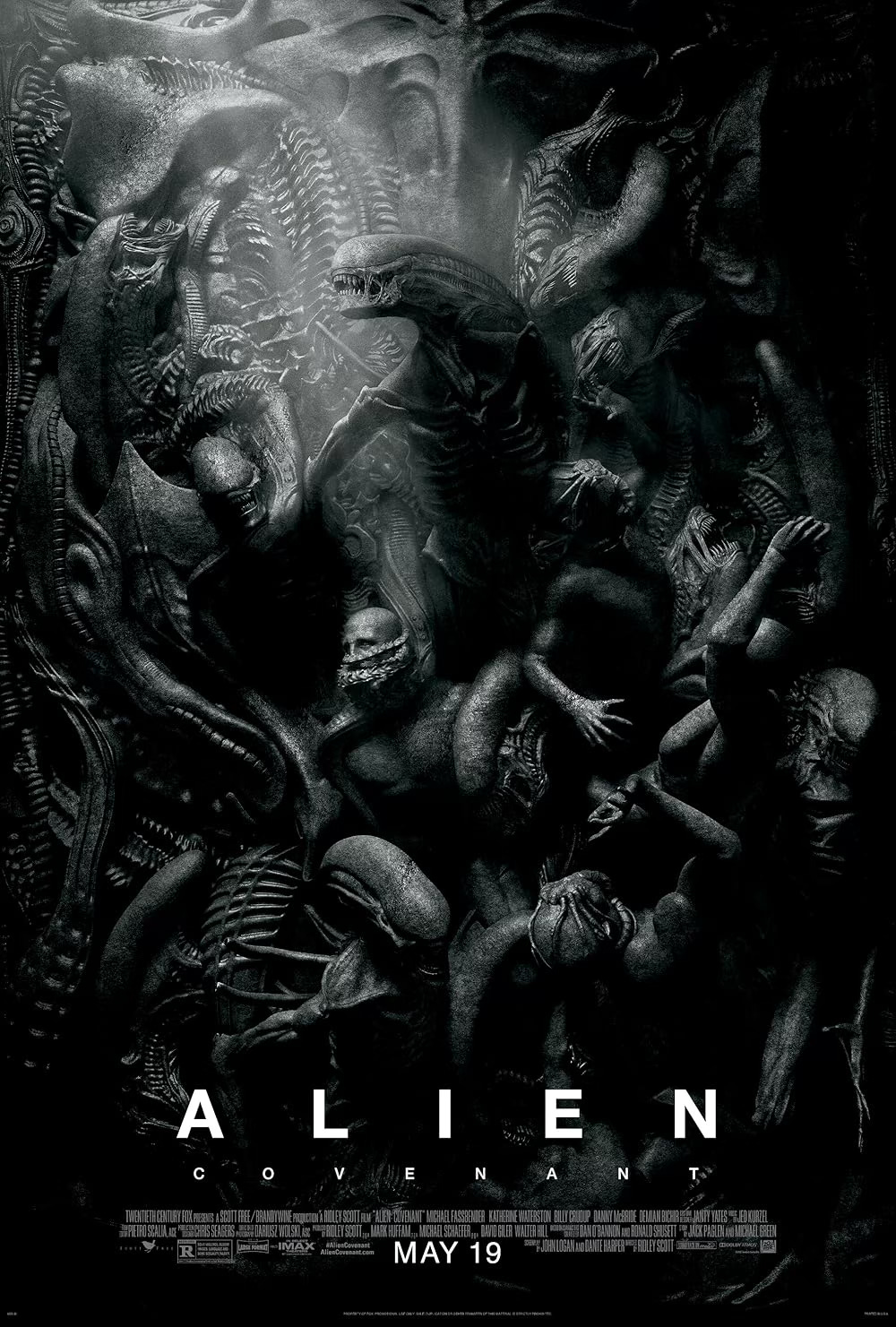
The best movie posters are not necessarily the most aesthetically pleasing, but those that provoke the imagination of the spectator, turning them into storytellers in their own minds as they begin to wonder about the cinematic potential contained within the artwork.
For those of us intrigued to see the continuation of Elizabeth Shaw and David’s journey as they searched for the Engineers’ homeland, what many of us hoped would be Prometheus 2, that version of the film never truly saw the light of day. Well, not exactly. Disappointment from sections of the fanbase over the absence of traditional xenomorphs in Prometheus (2012), coupled with Fox’s reluctance to finance another philosophically charged sequel focused primarily on the Engineers, led to a rewrite. What emerged was a film that retained fragments of that original direction but ultimately re-centred itself around the return of the creature that began it all.
And yet, it did not feel like a compromise. If anything, it generated even more excitement. Those who embraced Prometheus were, after all, originally Alien fans. So while it was suggested that the earlier philosophical ambitions had taken a step back to make room for the xenomorph’s return, the new direction appeared to promise the best of both worlds. That sense was reinforced in 2015, when a brief synopsis suggested that we might still visit the Engineers’ homeland:
"Bound for a remote planet on the far side of the galaxy, the crew of the colony ship Covenant discovers what they think is an uncharted paradise, but is actually a dark, dangerous world—whose sole inhabitant is the 'synthetic' David (Michael Fassbender), survivor of the doomed Prometheus expedition."
It was somewhat disappointing to see David referred to as the “sole inhabitant,” a phrasing that seemed to imply that Elizabeth Shaw, and possibly even the Engineers, would not be accompanying us on this next chapter. Yet the synopsis opened up a space for speculation that felt expansive. The notion that paradise conceals something far closer to hell is immediately intriguing. Hell, after all, is a concept open to interpretation. What form would it take here?
We knew the xenomorphs were returning but how would they fit into this setting? What had David been doing alone on this planet? The last time we saw him, he was nothing more than a severed head. If this truly was the Engineers’ homeland, how would a new crew respond to such a discovery? What would initially make it appear like an uncharted paradise, and at what point would it reveal itself as something far darker?
There was already more than enough to fuel the imagination. But then the official poster was unveiled, accelerating the speculation about what we might witness in this new chapter of the franchise, in arguably one of the most interesting pieces of artwork the series has produced.
How it provokes the imagination
Technically, a film poster is artwork in itself. However, the first thing that strikes you about this one is that it feels like classical artwork. Not just any artwork, but something influenced by European sculpture and painting. Picking up on that element is hardly rare. Many have noted the similarities to Auguste Rodin’s The Gates of Hell and Gustave Doré’s The Fall of the Rebellious Angels. But this resemblance is no coincidence. Doré, the nineteenth-century illustrator renowned for his engravings of John Milton’s Paradise Lost, material that heavily influenced Alien: Covenant, whose original title was Alien: Paradise Lost, is clearly echoed here.
This immediately signals that this is no simple slasher. Instead, it suggests a continuation of the philosophical undercurrents introduced in Prometheus, now merged with a narrative in which the xenomorphs appear to dominate. The connection to Milton invites speculation. How do the themes of Paradise Lost intersect with the presence of the “perfect organism”? We are confronted with imagery that implies intelligence and intention long before we are given narrative confirmation of either.
What we appear to see are Engineers being overpowered by the xenomorphs. They are no match for the creatures that engulf them, entangling them in what resembles a sculpted vision of hell. The implication is striking. In Prometheus, the Engineers were presented as superior, grander than humanity, perhaps even godlike. Yet here they seem powerless. What does this inversion suggest? Are we merely insignificant in a universe governed by forces beyond our comprehension? Humanity does not even feature in this composition. Is this a cold depiction of domination as a universal rule? If the xenomorphs triumph over the Engineers, is it the result of the Engineers’ own creation or something else entirely? And if they have fallen, does that extinguish our chance of ever understanding where we truly come from?
Perhaps this is simply a depiction of hell. The environment appears chaotic and claustrophobic, as though we are being dragged downward into darkness. There is something deeply unsettling about imagining ourselves within it. Yet light breaks through from above, illuminating the carnage below and most prominently, the ascending xenomorph at its centre. Is that illumination merely a visual device to signify dominance? Or could the light represent discovery? Might it even suggest that hope persists within the darkness, that this is not simply a vision of annihilation, but a struggle in which humanity may yet triumph? Is this what the crew of the Covenant encounter on their so-called “uncharted paradise”? If so, what are the consequences? How many, if any, will survive? And is this what David ultimately discovers? Could this even hint at the fate of Dr Elizabeth Shaw?
The poster’s design carries a mechanical, skeletal coldness reminiscent of H.R. Giger’s aesthetic, immediately recalling the original 1979 film and its director. There is also the return of the distinctive typography, the spaced lettering that signified isolation in the original Alien poster. In that sense, the artwork appears to satisfy both audiences: those who longed for the return of the xenomorph, and those captivated by the Engineers’ mythology. Whether the film’s combination of these elements was successful is open to debate. What is clear, however, is that the poster itself succeeded in provoking a fascinating range of possibilities within the spectator’s imagination.
So… Is the film as good as the poster?
If audiences thought Prometheus was divisive, then the reaction to Alien: Covenant took that division even further. The negative reception often seemed to dominate, though some of us admired what the film was doing.
While the film sought to satisfy those longing for the return of the xenomorph, its method of reintroducing the creature left a bitter taste for some. Ridley Scott continued his philosophical exploration of creation, though this time the film provided more answers than mystery and those answers were not to everyone’s liking. The origin of the xenomorph was explained, and while that revelation was embedded within an ambitious narrative, the sense of wonder inevitably shifted. For some, it vanished altogether. I did not see that revelation as a fatal misstep. If you are invested in the themes the film explores, you may be willing to overlook elements that at times verge on the excessive, such as the newly born xenomorph mimicking the movements of its creator.
One significant thread, however, remains unresolved. We do not see how the derelict ship ultimately came to rest on LV-426, leading into the events of Alien. Although we were teased with a sequel in which David would travel with his cargo of eggs to another Engineer-inhabited world, it now appears unlikely that we will see that continuation realised. It is reasonable to assume that we may never receive definitive answers and that may not be entirely disappointing. As the explorers aboard Prometheus discovered, and as some long-time fans felt in response to the explanation of the creature’s origin, answers to grand mysteries can unsettle more deeply than ignorance ever could.
The film is not flawless, but what it presented felt remarkably close to the kind of bold narrative a spectator might construct when letting their mind roam. Some films position themselves as more controlled and self-assured than the speculative conversations that surround them. Covenant does not distance itself from the expansive thinking fans engage in; it operates within that same imaginative space. It is because of that strength that one is willing to forgive its imperfections. After all, the speculative mind is never perfect.