

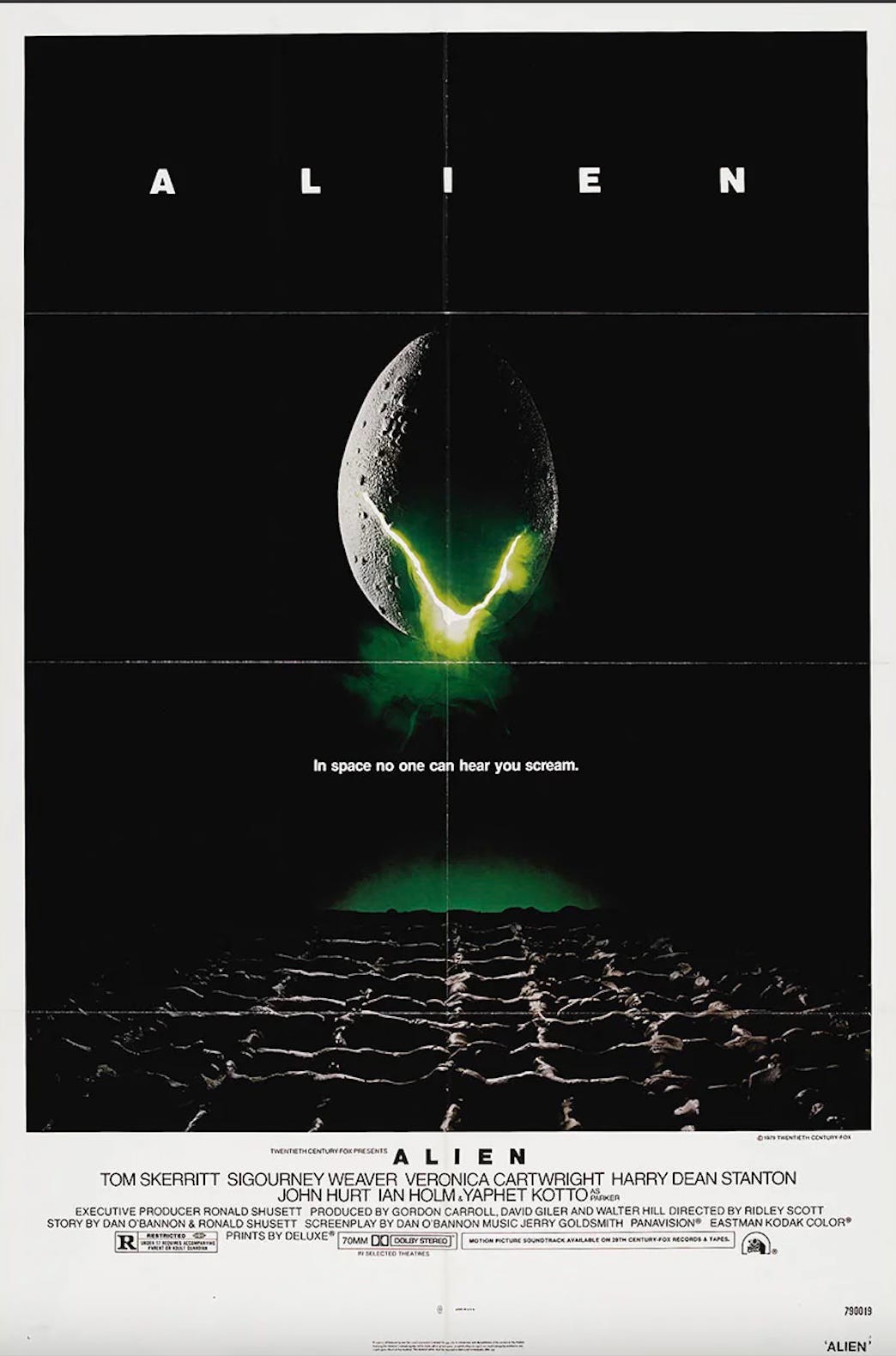
Graphic design by: Steve Frankfurt and Philip Gips
The best movie posters are not necessarily the most aesthetically pleasing, but those that provoke the imagination of the spectator, turning them into storytellers in their own minds as they begin to wonder about the cinematic potential contained within the artwork.
The British Film Institute recently held a retrospective of Ridley Scott’s finest films across its London venues, celebrating the director’s mastery of world-building cinema. At BFI Southbank, an accompanying exhibition offers insight into how these worlds are constructed, featuring storyboards, clapperboards, costumes, and film posters from Scott’s personal collection.
Among the posters on display were The Duellists (1977), Alien (1979), Blade Runner (1982), Thelma & Louise (1991), American Gangster (2007), and The Last Duel (2021), all presented in elegant black frames. While each is visually striking, none possesses the same power of seduction as the poster for Alien. Decades later, even for those familiar with the film, its sense of mystery and dread remains undiminished. Often cited as one of the greatest film posters of all time, the question remains: what makes it so effective?
How it provokes the imagination
Interestingly, the poster contains very little imagery drawn directly from the film. There is an egg, but it does not open from the side, nor does it emit an eerie neon-green glow as depicted here. While this misrepresents what appears on screen, it never feels deceptive. Instead, the inconsistency is forgiven, even welcomed, because whilst being aesthetically pleasing, the glow seeping from the crack invites speculation. What lurks inside? It stirs the imagination, even for those of us who have seen the film, as we’re looking at a different egg and possibly a different force. By presenting something recognisable yet altered, the poster reinforces the feeling of the unknown. The shadow obscuring the egg suggests something that should not be uncovered, drawing us toward the forbidden.
Perhaps the poster’s most powerful element is the tagline placed just below the centre of the image: “In space no one can hear you scream.” Its modest size forces the viewer to stop and engage. This is not a poster designed for passing glances; it demands attention. It draws you into the depths of the poster, as you sink into the empty blackness that almost entirely consumes it. Once you digest the words and contemplate the horror and isolation of being trapped in space without the possibility of outside forces attending to your screams to save you from a creature that we can only presume is a serious threat to life, a deep sense of dread runs through you.
The unusually wide spacing of the title lettering further reinforces this isolation. Any help, if it exists at all, feels impossibly distant. What heightens the dread is the absence of a visible threat. We are told only that something exists, something capable of making us scream. Even the surface beneath the egg is ambiguous, its texture unclear, provoking further unease. Is it stable ground, or something more ominous? What lurks within the depths of darkness, and what quantity? This mystery invites us to imagine the worst of our fears and provokes enough curiosity to want to witness what the characters discover on the planet, LV-426, making it one of the most effective posters of all time.
So… Is the film as good as the poster?
Although the poster features minimal elements, they combine to spark within you an intense curiosity. You want to see the film to answer the questions it raises, to bring clarity and resolution. But Alien offers no such comfort.
The creature revealed is unimaginable than anything the viewer might have suspected. The xenomorph’s design and biology were unlike anything seen in cinema before, and its lifecycle from facehugger to fully formed predator resists easy comprehension. The revelation still swarms with mysteries as you begin to wonder about the origins of the organism. Where did the derelict spacecraft come from? Who or what is the Space Jockey? Is the organism natural or engineered? And if engineered, then by whom? Are there more like it beyond LV-426? What other forces are there that exist that we do not know about?
These unanswered questions mirror the sense of wonder evoked by the poster. Where many films exhaust the mystery suggested by their marketing, Alien expands upon it. Instead of diminishing the imagination, it fuels it. This rare ability to sustain and even deepen uncertainty is what makes Alien as powerful as its poster, and perhaps even greater. The film doesn’t merely live up to the promise of its artwork; it transcends it.