

Watch the video review above
Richard Linklater’s Nouvelle Vague is a film about the making of Breathless (1960), and it left me more engaged than Breathless itself. By focusing not on the finished work but on the ideas and philosophy behind its creation, the film tells a story that feels richer than Jean-Luc Godard’s debut.
The film tells the story of Godard as he begins shooting his first feature at the dawn of the French New Wave. Breathless is commonly hailed as one of the most influential films ever made, thanks to its radical attitude in 1960 towards tearing apart conventional filmmaking. Godard ripped up the rulebook by introducing jump cuts, handheld camera work, and the use of natural light, a stark contrast to the polished, studio-bound French productions of the time.
For me, this philosophy and spirit behind Godard’s approach to Breathless is more compelling than the film itself. While I find Breathless satisfying to watch, it isn’t a film I adore, nor would I consider it one of my favourites or among my personal “best of” lists. I admittedly don’t have a great interest in the film, and I wouldn’t describe myself as a fan of Godard’s work overall. I found Alphaville (1965) to be one of the most tedious films I’ve ever watched, and while I admire certain elements of Weekend (1967), I struggle to appreciate any of his works as a complete whole. That being said, I haven’t seen every Godard film, so I may find myself backtracking in the future if I come across one that I genuinely think is brilliant.
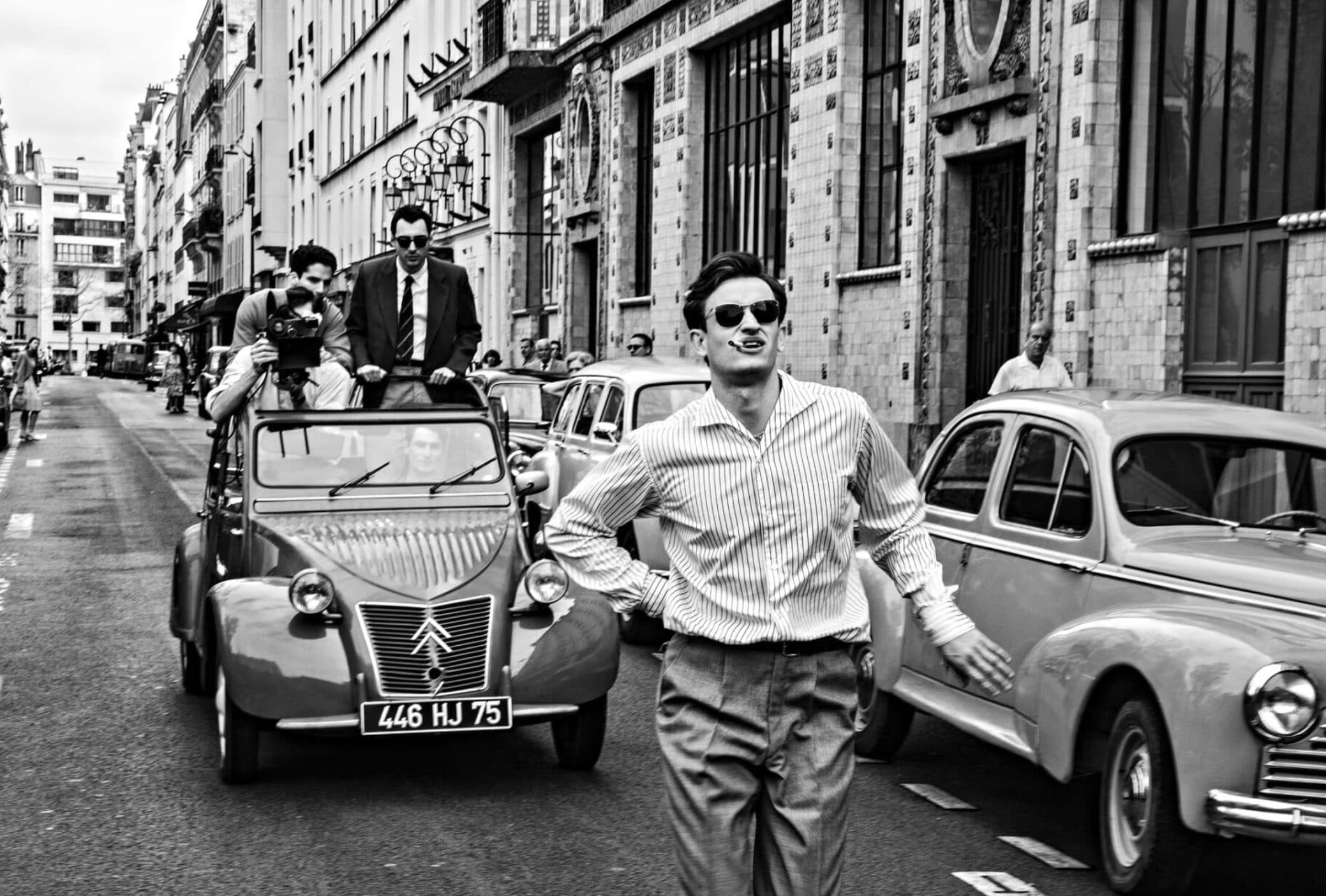
Some of you who share similar feelings towards Godard or Breathless or who haven’t engaged with his work at all may understandably feel little appetite to give Nouvelle Vague a chance. However, I would argue that if you’re a cinephile with a deep interest in filmmaking and cinema, this is a film you should absolutely watch, regardless of your feelings towards Breathless itself. Why? Because Nouvelle Vague feels like a love letter to a pivotal moment in film history, when the French New Wave emerged onto the scene. That alone should be of interest to anyone with a passion for cinema.
The dramatisation of this period offers numerous moments that will bring a smile to your face if you’re familiar with the movement. The film features many key figures from the French New Wave, including François Truffaut, Claude Chabrol, Jean-Pierre Melville, and Agnès Varda. One particularly charming sequence occurs when Godard and his crew stumble across Robert Bresson in the middle of shooting Pickpocket (1959).
Beyond the charm of seeing these iconic filmmakers portrayed on screen, the film is most engaging in its conversations about art and the creative process. Godard’s discussions with his friends and colleagues are especially interesting when he reflects on the role fear and terror play in the relationship between an artist and the work they wish to create. If you consider yourself an artist, you’ll likely find these exchanges intellectually stimulating, even without a deep interest in the French New Wave or Godard himself.

Linklater and the wider creative team have executed a work that assures you that this dramatisation was handled with an extremely competent pair of hands. Shot in black and white with a 4:3 aspect ratio, the film’s visual style is deeply woven into the period it explores, reinforcing its sense of time and place. The casting across the board is extremely strong, with each actor convincingly inhabiting the historical figures they portray.
If there’s one criticism to be made, it’s that Nouvelle Vague doesn’t always command your full attention. You’re not completely immersed in every moment, but this is partly due to getting lost in the film’s nostalgia. The themes and ideas encourage reflection, provoking your mind to wander, particularly if you already hold a deep interest in cinema.
Who would have thought that a dramatisation about the making of Breathless could end up being more compelling than the film itself? It’s a reminder that sometimes the story behind the creation of a work can be more fascinating than the artwork the filmmaker ultimately presents.
It’s intriguing to consider how many stories exist behind the camera that we’ve never had the chance to witness. While films like Nouvelle Vague do exist, it wouldn’t be a bad thing if cinema rewarded us with more of these stories, if not purely to entertain, then certainly to inspire.